Bulk hopper
Maintains a controlled product level without overloading the bowl or changing feed behaviour.
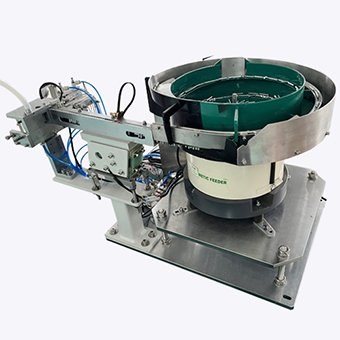
Feed, singulate and count
Automatically orient and separate loose components, detect each accepted part and release a preset quantity into a bag, box, kit or production process.
Direct answer
A bowl feeder counting machine uses controlled vibration and dedicated track tooling to turn a random bulk supply into a stable, separated stream. A sensor records each accepted component, while a buffer and positive gate divide production into the required quantities.
The feeder does not create accuracy on its own. Stable spacing at the detector and a clean stop between batches are just as important as the count signal.
Complete architecture
Maintains a controlled product level without overloading the bowl or changing feed behaviour.
Moves loose parts around a defined track while unsuitable orientations return for recirculation.
Creates stable spacing and holds parts between the bowl and the final counting point.
Optical, fibre, laser or vision sensing is matched to size, surface, speed and presentation.
Stops or diverts the flow so no part crosses into the next quantity during container change.
Ready, fill, complete and fault signals coordinate the counter with bags, boxes or assembly.
Application fit
It is a strong route for repeat components that tolerate recirculation and can be given a stable presentation. The important question is not simply whether the part fits in a bowl, but whether all approved variants can maintain one clean count event at the required sustained output.
Feeder comparison
| Feeding route | Strong starting application | Primary checks |
|---|---|---|
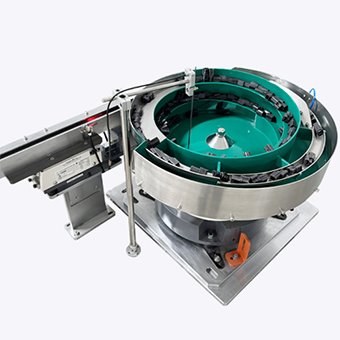
| Vibratory bowl | Repeat parts needing orientation or dedicated tooling | Recirculation, nesting, marking and noise |
| Linear feeder | Buffered metering after controlled bulk supply | Track width, spacing and product depth |
| Step feeder | Longer, heavier or lower-level parts | Lift geometry, gentle handling and final transfer |
| Flexible feeder | Higher variety with vision-guided selection | Cycle time, presentation probability and changeover |
Trial evidence
Frequently asked questions
Final suitability and performance depend on representative components and agreed acceptance criteria.
Ask about your component →A vibratory bowl meters and separates loose components, tooling rejects incorrect presentations, a linear track creates spacing and a sensor counts each accepted part before a gate releases the completed batch.
Repeat components that can be separated consistently are the strongest candidates, including many screws, nuts, washers, plugs, clips, caps, mouldings and connectors. Samples are required because geometry and bulk behaviour govern suitability.
A compatible family may run with recipes, guide adjustment or change tooling. Large differences in geometry, orientation or feed rate can require dedicated bowls or separate channels.
Optical sensors are common, but the detection method is selected from the part. Fibre-optic, laser, vision or another suitable sensor may be used when contrast, size or presentation makes a standard beam unsuitable.
Yes. A buffer and batch gate can coordinate the counted quantity with an open-bag station, pre-opened bagger, vertical bag-making machine, box, tray or assembly process.
Start with the component
We will identify the most credible feeding and counting route, then define the evidence needed for the next decision.