Through-beam photoelectric
A separated part interrupts the beam. This is a common robust route when the component silhouette is consistent.
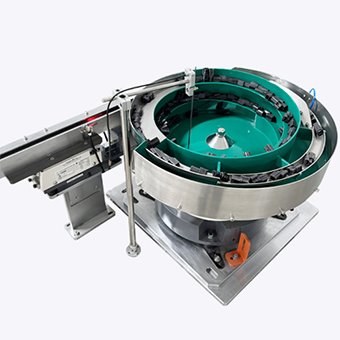
Sensor-based component counting
Photoelectric, fibre-optic, laser or light-curtain sensing can count singulated components at production speed when the feed path and detection zone are engineered together.
Direct answer
Optical parts counting is a strong starting route when loose components can be separated into a stable stream and each part can produce a repeatable sensor signal.
It is commonly integrated with a bowl feeder, step feeder, linear track or conveyor and a positive batch gate.
Sensor routes
A separated part interrupts the beam. This is a common robust route when the component silhouette is consistent.
Compact heads can create a small detection zone for miniature parts or restricted machine areas.
A fine beam may help resolve small features, subject to surface, alignment and safety requirements.
Multiple beams provide a wider sensing field for irregular falling paths or varying profiles.
Useful in selected layouts where a beam cannot pass through, but background and finish variation matter.
A camera can distinguish features or confirm type where a binary sensor event is not enough.
Detection-zone design
The feeder, track, sensor, controller, slowdown point, gate and discharge are treated as one timed process. A high-specification sensor cannot compensate for uncontrolled overlaps or an undefined batch boundary.
Method comparison
| Method | Best starting fit | Primary limitation to test |
|---|---|---|
| Optical sensor | Singulated repeat parts | Touching parts and signal consistency |
| Light curtain | Variable falling position or profile | Occlusion, clusters and interpretation |
| Machine vision | Feature recognition or complex presentation | Lighting, overlap and validation set |
| Count by weight | Stable unit mass without singulation | Piece-weight and tare variation |
Frequently asked questions
Final suitability and performance depend on representative components, operating conditions and agreed acceptance criteria.
Ask about your component →The feeder creates a controlled stream and each accepted component interrupts or reflects a beam. The controller validates the signal, adds it to the active batch and coordinates slowdown, gating and discharge at the target quantity.
Potentially, but standard photoelectric sensing may be unreliable. Fibre-optic, laser, contrast, ultrasonic or vision methods may be assessed using every transparent colour and finish in the production range.
Bounce, holes, multiple reflective faces, touching parts or an unstable detection zone can create more than one signal. Sensor configuration and mechanical presentation must be validated together.
No. A light curtain uses multiple beams across a wider detection area, which can help with variable falling positions or irregular profiles. The application still needs controlled separation and validated signal logic.
Yes. An optical sensor can provide the primary count while a camera verifies orientation, type or selected features before the batch is released.
Start with the component
We will identify the most credible feeding and counting route, then define the evidence needed for the next decision.